Sporomex Ltd:
A Novel Encapsulation Technology

New pollen derived products for the pharmaceutical, food and cosmetic industries

Sporomex is a spin-out company from the University of Hull Department of Chemistry and the Medical School. Combining the skills of chemical attachment or physical encapsulation with the knowledge of drugs and their mechanisms has enabled Sporomex to develop novel drug, nutraceutical and cosmetic delivery systems. These have the potential to deliver orally drugs that are usually delivered by injection, more exactly target certain drugs and/or protect an active ingredient so that it can be delivered to the lower gut or skin.

Other possible uses of this technology include the enhancement of medical imaging, especially MRI and the protection of oxidisable active ingredients for skin care, household or industrial use.

The oral delivery system here is based upon the fact that certain plant pollens or other spores are capable of crossing the gut wall, largely intact, but is then destroyed within the blood stream, thereby releasing its contents. Dr Grahame Mackenzie (Reader in Chemistry) has developed chemical and physical methods by which a large variety of chemical entities including peptides, nucleotides and metals can be attached to or encapsulated within the empty exine coating of these spores or pollens. Although larger spore exine coatings > 25 microns, do not rapidly enter the blood stream, they can be made to release their contents over a period lower down in the gut. This can be used to aid the delivery of nutraceuticals and other food additives Very high loadings are possible using encapsulation and more than weight for weight is possible in many circumstances. In addition, more than one type of drug is able to be attached to a single vehicle, should this be required. Prof. Stephen Atkin has expertise in diabetes and endocrinology and has shown the feasibility of the vehicle in its absorption and that it is unaffected by eating food before ingestion.

A separate pulmonary technique enables a drug to be targeted at specific regions of the lung. Many current methods of treating lung diseases use far more active drug ingredient than is really needed. This is because a specific size of particle will be deposited in a particular part of the lung, but most delivery vehicles have a wide range of particle sizes. This means that drug attached to larger particles may be deposited in the nose or upper respiratory tract, whereas that attached to very small particles doesn’t settle in the lungs and is breathed out again. The spore from a particular source is monodispersed i.e. has the same particle diameter to within a micron. This can be chosen according to use. Currently exine coatings have been produced with diameters of 4,15, 25 and 40 microns. Other sizes will be prepared as required.

The Oral Delivery Vehicle

The spores and pollens are a natural, renewable material with several important intrinsic properties. Firstly their exine coatings are unaffected by either highly acidic or alkaline conditions and is relatively elastic. This means that they can pass into the stomach largely unchanged and so protect any medically active ingredient that has been attached to, or contained within it, that would otherwise be destroyed in the stomach. Therefore some drugs, which had previously been rejected because they were unable to get into the bloodstream, may now become viable.

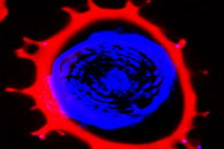
Secondly it has the ability to pass largely intact through the gut wall into the blood stream. Most of this transition takes place within 30 minutes, so the effect of the drug takes place very rapidly. In a limited phase 1 study, ingestion of the vehicle in fasting and non-fasting subjects showed absorption of the entire vehicle by light microscopy, within 5 minutes and then progressive decomposing of the vehicle over a 1 hour period. Figure 1 shows spore exine disintegrating in blood plasma. The red is the exine and the blue is oil that is being released from the shell.

Additional studies with encapsulated thyroxine have also been performed. Calculations show that it is possible to give doses of many drugs, at the levels required for treatment, within a single tablet, using this vehicle.

Figure 1 

Confocal pictures of exine coatings breaking up in blood plasma


Preparation of the Exine Coatings

Complete spores and pollens have the disadvantage that they contain proteins and carbohydrates, which fill up their centre and may cause allergies. By treating them with phosphoric acid and sodium hydroxide, this material is removed leaving a hollow, largely spherical shaped particle, frequently composed of sporopollenin. This is a lipid like material composed only of carbon, hydrogen and oxygen and is therefore likely to be allergy free.

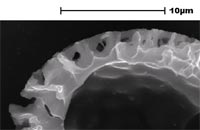
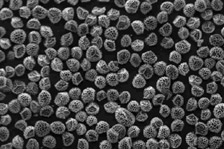
Figure 2 is a scanning electron microscope picture of a collection of ambrosia spores illustrating their size uniformity, whilst Figure 3 shows the larger spores and exine coatings from Lycopodium Clavatum. Figure 4 is a confocal microscope cross section of one of these spores showing its filling material, whereas Figure 5 shows an empty shell of the exine coating following treatment.

Figure 2

SEM picture of Ambrosia spores


Figure 3    
  Extracted sporopollenin exines from Lycopodium clavatum showing uniformity of size and morphology Extracted sporopollenin exines from Lycopodium clavatum showing morphology; decorated honeycomb like surface and trilite scar.

Figure 4 Figure 5
Raw Lycopodium clavatum spores showing the contents of the spores required for plant reproduction. Extracted sporopollenin exines from Lycopodium clavatum showing morphology; a decorated honeycomb like surface and trilite scar.

Physically Loading the Exine Shells.

The exine shells appear to have nano-sized holes running through them, which enables the central spore material to be removed and replaced by a suitable active compound or nutraceutical (see bottom section of Figure2). Certain substances such as ethanol greatly enhance the filling rate. The active ingredient or nutraceutical must be in liquid form, either naturally or in solution. Where a fat is being encapsulated e.g. Omega 3, only a little penetrating aiding liquid is required and the central cavity is largely filled. This liquid can then be evaporated off before use leaving an essentially full cavity. (see Figure 6 and Video 1 which show a series of sections through a single spore). The process is extremely rapid, the attached Video 2 shows a tablet of compressed exines from lycopodium clavatum in sunflower oil, but very little filling occurs.Penetrating aiding liquid is added via a syringe and the fat is then absorbed very quickly into the exines. Video 3 shows the rapid reaction that happens when a compressed tablet is added directly to a mixture of warm oil and penetrating aiding liquid.

Figure 6
Section 1 Section 2 Section 3 Section 4 Section 5 Section 6

Stepwise sections of encapsulated Nile red dye.
The exines were washed with ethanol-water and show no trace of dye on the surface

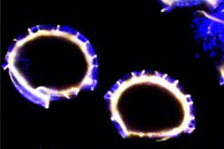
Other materials such as proteins, vitamins or enzymes etc are dissolved in aqueous or organic solvents. Once again these solvents/dispersants are evaporated leaving material on the inside, although sometimes in smaller amounts. The higher the concentration the greater the percentage capable of being encapsulated. Figures 7 shows confocal microscope sections of spores containing different types of material.

Figure 7
Encapsulated dyed sunflower oil showing high levels of encapsulation with very little oil on the surface (small red spots) of smooth 40 micron sporopollenin exine coatings Encapsulated ascorbic acid showing a clean outer surface on 25 micron exine coatings

Toxicology Studies

In order to assess the effects of the vehicle on cells, the vehicle was added in increasing concentration to growing human endothelial cells. Two types of cells were used, firstly human umbilical vein endothelial cells (HUVEC) which are endothelial cells extracted from the vein of an umbilical cord. The second source of cells was the endothelial cell line EAhy 926. Proliferation, apoptosis and necrosis were assessed, together with direct microscopic examination. No difference in proliferation, apoptosis and necrosis were seen at any concentration used, suggesting that no direct toxic effect of the vehicle was present.

Figure 8 Effects of vehicle on HUVECs
Control HUVECs (X100)
+1ug/ml vehicle (X100) +10ug/ml vehicle (X100)

Figure 8 shows photomicrographs of HUVEC cells treated with the vehicle. There was no evidence of any cellular damage.

In a further study, WST-1 assay was used to study the effects of vehicle on HUVECS growth (+/- SEM n=5). The addition of vehicle at the concentrations 100ng-10ug did not reduce proliferation of the HUVEC cells when compared to the untreated control. Another independent study by A Maack, RTC GmbH, Schipperkamp 29, 31717 Nordsehl, Germany again failed to show that sporopollenin had any toxic effect. This group has developed soluble sporopollenin for skin treatment and other uses. For further details e-mail drmaack@aol.com.

IP Situation

Patent applications have been filed in the USA, Malaysia, Australia, Brazil, Canada, China, E.U., India, Japan, Korea, Mexico, Philippines and South Africa concerning this vehicle and its use. The published USA patent application 20050002963 can be found by clicking here.

A further patent application on the use of the technology to enhance medical imaging is filed in the UK and PCT (PCT/GB2005/004824). The principle behind this is that the exine coatings concentrate a material e.g. a oil, in a particular part of the body, where it then shows up brightly within the scanner. The picture shown in Figure 9 was obtained after drinking the exine coatings loaded with fish oil in milk.

Two further patent applications related to delivery systems with anti-oxidant properties (WO -2007/012856 and WO – 2007/012857) were published in February 2007. These have particular relevance to the food and cosmetic industries and further details are given below.

Figure 9

Ten minutes after the ingestion of oil filled exine. Stomach mucosa
highlighted by exine (arrow) and increased signal in the small vessels of the liver
– shown in the region of interest highlighted by box.


Food and Cosmetic Applications

The exine shells can be re-filled with relatively high quantities of other materials in particular fats. Twenty five micron diameter exines from Lycopodium Clavatum can hold four times its own weight and yet act as a dry powder. Larger exines e.g. from maize can hold more than ten times their own weight. The exine in nature protects the central genetic material from oxidation by UV light and continues to provide this protection when the centre is refilled by, for instance, an oil. More surprisingly it has been discovered that certain exines have additional anti-oxidant properties of their own. The exine also provides taste masking in the mouth. The high loading, taste masking and anti-oxidant properties therefore make this technology ideal for the delivery of unpleasant tasting, easily oxidisable substances such as fish oils.

Another property of interest to the cosmetic industry is the possibility of release from the exine by simply rubbing the particles onto the skin. It is therefore possible to protect the active ingredient whilst it is within a cream, but for this to be released as it is applied.

Plans for 2008

Sporomex currently has several development agreements with international companies, in order to carry out feasibility studies on this technique in their particular fields. Further development agreements are being sought in other areas, particularly to develop the respiratory approach and for the encapsulation of nutraceutical materials. It is intended to plan and commence the construction of a laboratory dedicated to this technology.

Further Information

Contact Dr Steve Beckett , at S.T.Beckett@sporomex.co.uk or telephone 44 (0)1904 760041.